Showing posts with label Reggio. Show all posts

Tuesday, May 22, 2012

We've got mail

I was very excited to discover Lucy quietly at work in the studio this morning, on a project of her own design.  She'd collected clay, twist ties, wooden beads, and bamboo from their various places and brought them all to the table.

When I came in, she was just beginning her second in a three-part series (one for "mommy, mama, and Lucy--our whole family!"):
As she finished each one, she ran across the studio
to deliver them to our mailboxes.  (There's one there for each of the kids in our early childhood program, as well as for Andi and I.)
(I've just recently returned from a Reggio-inspired teachers' conference at which Lella Gandini described the three-year-old classrooms' mailboxes being transparent, because three-year-olds might put anything in there, such as a half-sucked lollipop.   :-)  So the intentionality in three-year-old Lucy's mailed gifts particularly struck me today.)

Thursday, July 29, 2010

In the studio: overhead design

Continuing with my in-the-studio series of happenings from my early childhood program, here's a story from this week.

I came into the studio to find this on the overhead projector:

and this on the table:

Apparently, the overhead-projector design/drawings had been going on for a while.
There were also glass gems:

And chalkboard erasers:

2 kids, working together, on a project of their own design. They chose the materials, arranged them on the projector, and looked at the projected image to draw what they'd made. I love their imaginative use of materials (glass gems on the overhead--expected. But erasers?). And I love the culture of drawing we've established here, so that when they do something cool, their instinct is to draw it.

(I've been inspired by the preschools of Reggio Emilia, Italy, to offer lots of opportunities for children to explore light--as with the overhead projector, which is always available to the children in our studio. And to encourage children to think in more than one "language" (i.e. ways of expressing themselves)--such as here, moving from the "language" of arranging materials to the "language" of drawing.)

Thursday, July 22, 2010

Sharing the bird love

This week, Lucy and I had an unexpected, much-needed, gift of a free day. We took a road trip to visit my great friend, Julie.

Her unschooled, bird-loving daughters, knowing Lucy's passion for birds, set up this provocation* for her on their coffee table:

My favorite bits:
the pink bird, attached by a hair tie to a paintbrush so she could make it fly,
the small bird attached by wire to the eagle, so it appeared to be flying,
the green parrot, whose curves are aligned with the mussel shell it's set beside.

Later, they donned bird beaks as they made music together.

It was so cool to me that a 1-year-old, a 6-year-old, and an 8-year-old could bond over a shared interest in such lovely ways. Thank goodness for great friends and shared philosphies. It was just what we needed.

* Provocation is a word used in Reggio-inspired teaching, meaning something set up to provoke children's thinking.

Thursday, July 8, 2010

On failing to make a solar-powered boat

Our days over the past week have been filled with boat building. It began in the river, with simple leaf-and-stick creations.

Back in the studio, I offered wood pieces, craft sticks, corks, and glue guns, and the children began to draw their ideas for more boats.

A quick lesson in the safe use of a glue gun, and they were off on what would become an extended boat-building project.


We're using a tub of water to test our creations for floatability before they're set afloat on the river.


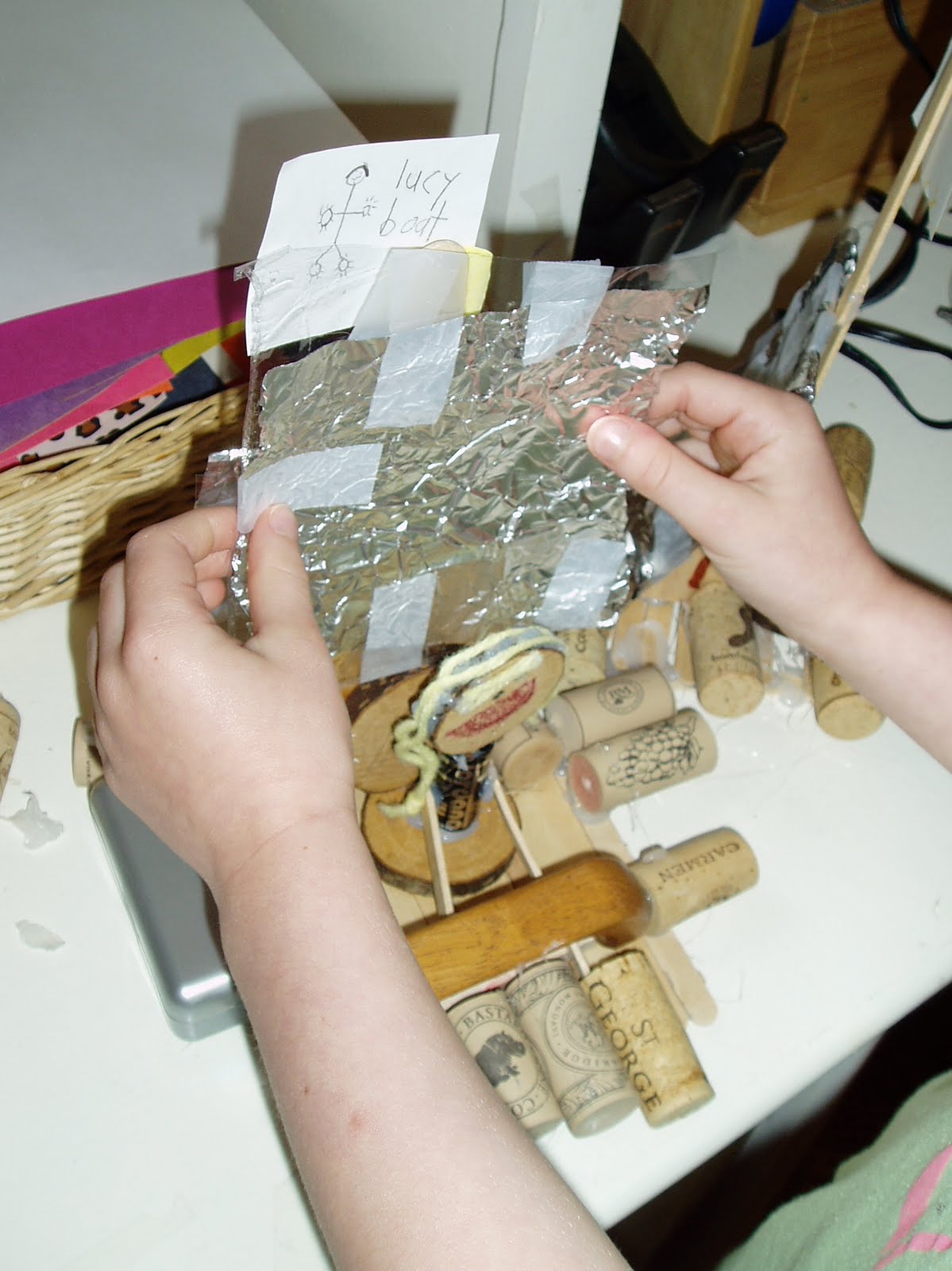
The children return to their boats day after day, adding more and more: an anchor, some "guys," a treasure chest, a sail. But how to make them go? That's been quite the debate. With excited discussion, the children decided they should be solar powered, using tin foil and clear plastic to create the "solar system."

Here's the email I sent their parents today, talking about this struggle to create a working "solar system":

"We barely made it outside this morning, or paused to eat anything for snack, because the boat construction was just too compelling.

The children's work on these boats is so exciting and impressive and beautiful to watch. It's also a little painful. They have these fabulous plans to create a solar-powered vehicle, but only the vaguest idea of how to make that work. This happens all the time in children's creations. They want a car that really drives, a walkie-talkie that really sends messages, an airplane they can actually fly in. And as the adult, you want to talk them down from their lofty plans, so they don't get disappointed. Or make it work for them, so they'll be proud and satisfied. I can't answer the solar-power question (I don't understand it well enough myself). I could research it and offer books and explanations. I could buy a kit. But I don't really think that should be my role--because I don't think that's where the real learning comes in. If they assemble the solar-power kit, do they better understand how it works? Not much. But they will learn that the answers lie with someone else; that they can buy a solution; that they are not capable of finding a solution on their own. J. just asked me to set his boat out in the sun while he napped so it could "charge." What will he learn when he brings it back in? And what will he decide to do about it? I think in the process, he'll learn so much more than he would from my potential "lessons."

Conveniently, this wonderful post came along today, to support me as I briefly questioned my hands-off thinking.

What a thrilling project this has become! I can barely wait to take the boats to the river to sail. (Of course, that's my adult need for the "product" again. My best teacher intentions remind me to slow down and not rush the process, which is the most important part. We may be building for weeks before the boats have their inaugural voyage.) Wait. Watch. Support. Don't push. Don't solve it for them. Let them fail sometimes. It will come...and it will be rich and deep and meaningful and theirs."

I write to the families in my program daily--and attach documentation panels about the work the children are doing--and often, that's my best, most creative work. But somehow, it's felt odd to share it here. What do you think? Do you want to hear about it sometimes?

Thursday, June 24, 2010

A peek into a morning in the purple house

I've been quieter than usual here in this space, but life has been anything but. With little time to post today, I thought I'd share just a quick peek into our day...

The day began slowly, with just a few children checking out the changes to our resident tadpole (all four legs now, and a shorter tail) and getting our first glimpse at all the river creatures we caught yesterday (the silt has finally settled and the water cleared enough for viewing). We started out with a handy identification guide, pencils, and paper:

As the house filled with more children, the table and couch filled with more evidence of our work. Out came a favorite book about frogs. Talk of frog life cycles reminded us to pull out the frog-life-cycle puzzle:

Pages filled with sketches:

Some of those pages were turned into a book (this page says "A kapl day rlr my teche had kot a talpl," or, for those not accustomed to invented spelling: "A couple days earlier my teacher had caught a tadpole."):

And then it was time for snack (morning snack that is; our day had just barely begun).

The day continued in a whirlwind, as always, and now I've got to be off to tidy it all up and prepare for tomorrow...

Tuesday, June 23, 2009

New field bags


Here is one of the field bags that nearly destroyed my sewing machine. Each is slightly different, but they all contain the same supplies. They're embroidered with the children's names, in the color which helps them identify all their belongings at my house.

The children in my program are between 1 and 5 years old. We're starting small and simple with these bags, and will work up to more later. For now, they contain:
a beautiful little sketch pad
a pencil
a small magnifying lens
a tulle collection bag for rocks, bark, flowers, etc, etc, etc.

As the children get older and more used to using their field bags, I expect to add:
watercolor paints (thus the really nice sketch books which work beautifully with watercolors)
field guides appropriate to wherever we're headed and whatever we're into at the moment
critter collection containers
and...? We'll see what comes from the children's pursuits.

Lori Pickert, another Reggio-inspired educator, has a great tutorial on her blog for how to make a field bag from recycled clothing. I'd wanted to have field bags for the kids, and her blog gave me just the kick in the ratty-old-mom-jeans I needed to get going on making them.