Showing posts with label food preservation. Show all posts

Friday, September 24, 2010

Books to read while the canning pot boils


I promised I'd share a booklist for what I've come to think of as our "squirreling away" project (our current investigation of storing up food for winter, focused in part on the comparison between us and animals, especially squirrels.) The books we're reading now have some overlap with last year's autumn book basket, but as we read, we have a different perspective found through the lens of our recent experiences foraging, collecting acorns, making jelly, and picking and eating apples.

I'm afraid this might become a marathon post, so I'll break it into a few smaller ones (you know I tend to go on and on about children's books!). These are the food-storage by humans ones.

Have I told you about Librarything? It's one of my all-time favorite online tools. I've used it to catalog all my books. It's super-helpful for teachers or parents who want to follow up on children's very specific interests, because you can tag all your books with whatever keywords you want. After years of going to the school librarian asking "can you think of any books about string?" (for one of my most-frustrating examples) and ending up with only one non-fiction title from the computer card catalog, I am thrilled to be able to find all the books I've got that show inspiring uses of string. (If your kids--like many of those in my past classes--happen to be into string, you may be interested in my collection of books tagged "string,"or in the books tagged "string" by anyone on librarything.)

So, for example, as I began to notice the children's interest in all the food preservation that was going on around them, and in acorns, and squirrels, I searched my librarything catalog for "food storage," "canning," "squirrels," "acorns," "apples," and "foraging." Here are some that I chose from those that came up (for a group that's currently a 1 1/2-year-old, 3 2-year-olds, a 3-year-old, and a 4-year-old).

Blueberries for Sal by Robert McCloskey. Of course. Is there any more classic, more beautiful story about the experience of gathering food for the winter? And it's about both people and animals. And that picture of the kitchen on the endpapers? I could move right in, and I find myself spending as much time discussing that illustration as reading the rest of the book! (And the fact that Sal is playing with a spoon and canning rings rather than toys? Perfect.)


Autumn Story by Jill Barklem. The mice gather berries just as we're doing. And the illustrations of their well-stocked pantry shelves full of canning, and ceilings strung with drying food, and baskets and baskets of berries covering the floor? Fabulous.


Let's Find Out About Fall by Martha and Charles Shapp. One of the advantages of vintage books is that they come with vintage assumptions: like everyone's gathering stuff from their garden and preserving it for winter. Just a brief mention, here, but I like normalizing "weird" habits like local eating by having them come up in many ways in many books.


Frederick by Leo Lionni. A twist on the old "The Ant and the Grasshopper" fable, except that here, the "lazy" one is an artist, gathering the sun rays and colors and words the others will need as their food stores run low. A good reminder of the different gifts we each contribute to our communities.


Hurry, Hurry, Mary Dear by N. M. Bodecker and Erik Blegvad. What a score when I came across this one at a library sale! "Pick the apples, dill the pickles, chop down trees for wooden nickels. Dig the turnips, split the peas, cook molasses, curdle cheese." Etc, etc, etc...all the tasks Mary takes on to prepare for winter, while her husband lazes about. Great illustrations, so much to talk about, and a reflection of all the skills (and more) I'm trying to learn and share with the kids.

By the way...if you click on a link and find yourself at IndieBound, and then buy a book through there from your local independent bookstore, I should theoretically earn a bit of change (hasn't happened yet). If you find yourself at Librarything, it's because IndieBound didn't have it and I want you to see the book without finding yourself at an online giant retailer.

Coming up next...books about apples and acorns and squirrels, oh, my!

Wednesday, September 22, 2010

By 9 am


I'm getting much better at squeezing in small amounts of food storage whenever I have a bit of time, rather than doing all of it in marathon sessions that keep me up until the wee hours (though lots of it does still happen that way). We had a half peck of peaches at peak ripeness, and a bag of apples given to us by a parent in my program ("can you use these? They're kind of spotty..."). So this morning, as the coffee perked, I cut up apples and put them on the stove to cook. After breakfast, Lucy and I ran them through the food mill and put the sauce into jars. As they processed, I peeled peaches, greeting the arriving children in my apron with peaches in my hands. They went into the canner just as the last child arrived, so I was able to begin my day with them with a bit more fruit for our shelves. (Then we sat down to a snack of toast with the crabapple-wild grape jelly we'd foraged and cooked up together...mmm! I'd made that yesterday when one of the kids came in asking "how's that jam coming?" Umm...not at all...I'd forgotten to finish it. It was just a bit, so we didn't can it, but popped it in the fridge for some immediate gratification.)

Wednesday, September 15, 2010

A-foraging we will go


Lucy adds acorns, gathered on a walk to the park, to clay in the studio.
Watching her, I realized we were nearly out of acorns, and asked if the kids wanted to gather some more.


We're back in the swing of things, here, and it's been a busy first week and a half with the kids! I was sitting back, observing the kids at play, watching for that beautiful moment that signals the beginning of a possible ongoing group investigation, when I realized that--of course--food preservation had taken center stage again. How could it be otherwise in the autumn, in a house where we're at the height of storing up for the winter? Naturally, the kids' play and interests reflect that which is going on all around them.

This year, we've been noticing the similarities between our work and that of the squirrels and other animals around us, all gathering, gathering, gathering. Here's a bit of the story, so far.


Everyone was game for an acorn-hunting walk. But setting off with our baskets reminded one of them that "we could pick crabapples" at another local park. That became the plan for the next day. In the meantime, I introduced them to the idea of acorns as food.

The acorns we gathered--plus a few other discoveries.

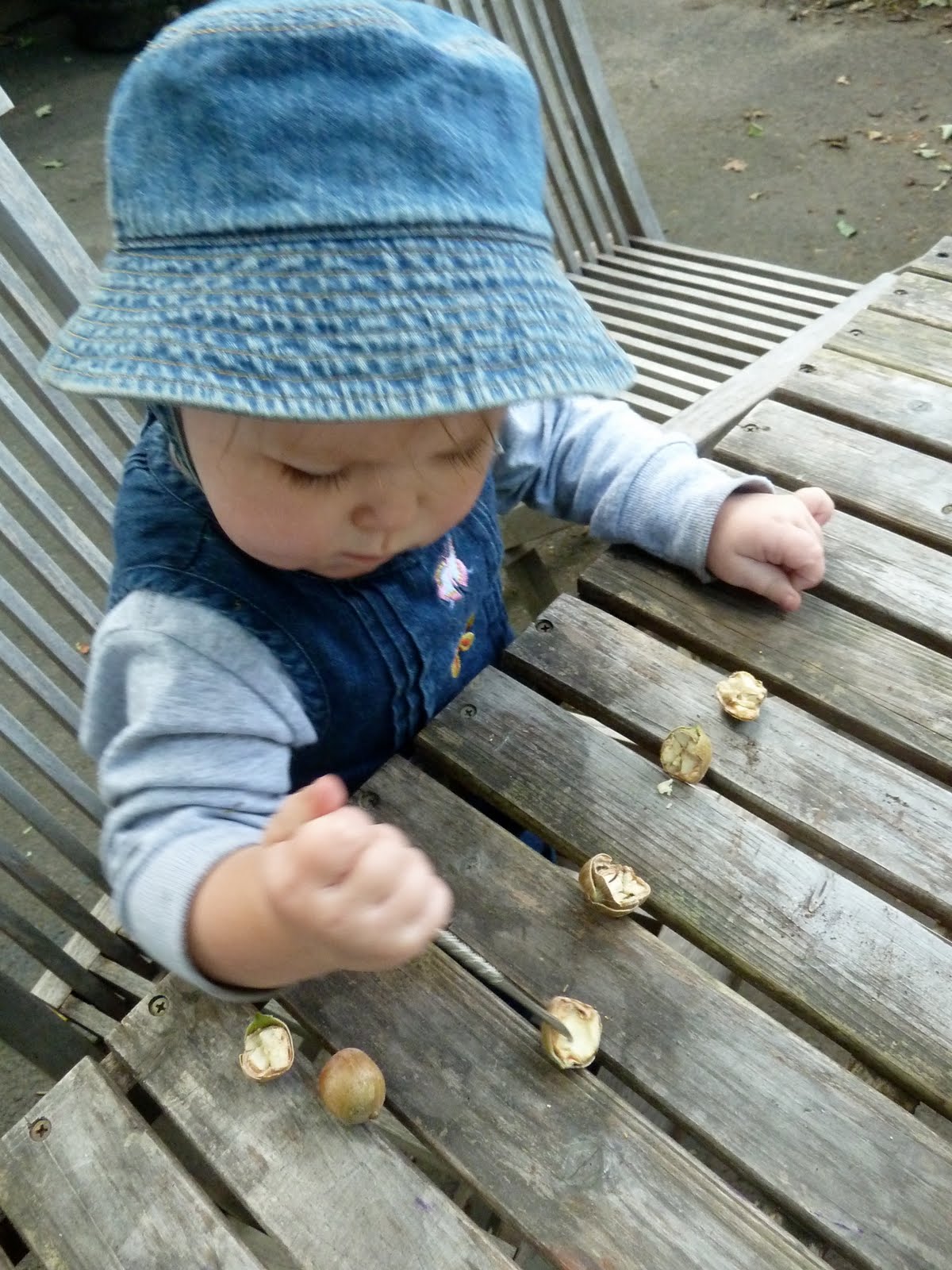
We used a hammer and a brick to break the acorns, and nutpicks to remove the meat.

Acorns to be processed, caps for the studio, shells for the compost.

This morning, this invitation to continue the work awaited them on the coffee table, along with a book which elicited many shouts of "we picked those!" (Oh, I had such fun pulling books to support this interest! I'll share a book list soon.)

The hunt for crabapples was disappointing (they were mostly gone), so we moved on to gathering wild grapes and goldenrod, instead.

Heading home after a successful foraging expedition.

At the moment, we've got acorns waiting to be cracked and processed into acorn meal (with the promise of acorn bread in our future--for the equinox, maybe?), wild grapes and crabapples dripping juice through a bag, to be made into jelly, and goldenrod waiting to be made into salve. And those are just the with-the-kids projects; never mind the tomatoes, beets, carrots, and more I plan to preserve this week!

Monday, July 26, 2010

Independence Days challenge: green beans


Time again for Sharon's Independence Day's Challenge, already? I've been a slacker blogger this week! Sorry. Summer's a crazy time around here, and it's been hot, hot, hot!! (Makes me grumpy.) Here's my meager update.

2. Harvest something:
Eggs. Grape tomatoes. 11 lbs. green beans from our CSA.

3. Preserve something:
4 1/2 pts. pickled beets with anise. 25 pts frozen green beans. 2 qts. frozen stock.

7. Eat the food:
Lots of zucchini-nut muffins. A rice-lentil-carrot-cabbage-basil salad that came out surprisingly well (with mayo/lemon juice dressing). Another, also good (I think I may actually be learning how to make up recipes--finally, at 41!): chick peas, lemon juice, lots of basil, grated carrots and turnips, chopped lettuce and scallions. Delicious zucchini cakes (our new favorite recipe is from Nourishing Traditions). Sweet and sour chard over rice.

Tuesday, July 20, 2010

Independence Days challenge: the container garden is working!


Time again for Sharon's Independence Day's Challenge:

1. Plant something:
Well, I haven't planted anything this week. But I've tended my pots, and I'm thrilled--they're working! I grew things from seed and they're actually growing. Look at those beans, reaching for the sky! And the kidney beans and cucumbers are covered in blooms. Yay!

2. Harvest something:
3/4 lb. purple potatoes (total harvest from one trash can; very disappointing! Wonder what I did wrong this time...). A few more grape tomatoes. Sunflowers, basil, and rosemary from our CSA.

3. Preserve something:
7 1/2 pts. plum jam using this recipe (way more sugar than I normally like to use, but I liked this recipe's simple plan for seed removal and don't trust myself enough to mess with recipes yet). 5 pts. plum jam using the low-sugar Pomona pectin recipe. 4 1/2 qts. dill pickles. 2 pts. anise beets. Dried a bit each of carrots, rosemary, and greens for the chickens.

5. Preparation and storage:
Had a bit of good luck at tag sales this weekend: got a hand drill and a collection of drill bits, a life jacket, and a child-sized spade. And I got a handful of wonderful vintage children's sewing patterns at a thrift store, as well as a pile of great children's books.

7. Eat the food:
A good potato salad with green beans and hard-boiled eggs. Raspberry-plum-lettuce popsicles. Lots of carrots and zucchini. A pretty-good grilled zucchini pizza (would have been really good if I could learn to make a better crust.) Tomatoes straight out of the garden. Nothing particularly interesting, but fresh and good.

Thursday, July 15, 2010

Plum jam 2 ways


Please excuse my slow mid-week posting lately. For some, summer's a slower, more relaxed time. For us, summer's when life kicks up a notch in intensity--I'm focusing on the current children's work, prepping for four kids to move on to kindergarten, working on enrollment for next year, prepping for the new children, taking care of my own family, and constantly preparing food for storage for the winter. It's a whirlwind.

So imagine me one day this week with 6 children under 6--several using glue guns while they work on their boats; Lucy under my feet or on the counter beside me--processing 12 qts of plums which had to be dealt with immediately (i.e. a day ago; some were already rotting). Crazy!

(Wondering how to can with a 17-month-old? The best moments were these... Lucy sat on the counter beside me with a huge bowl of plums. Her job was to hand me each one so I could slice it with a knife and put it in the pot. That lasted a good while. When she tired of that, she moved on to the floor, where she used doled out small handfuls of catfood into the children's pots and pans and little dishes for a good long time. The resulting mess was well worth it. The less-fun moments involve a hot toddler in a hot sling while I twist my body away from the boiling jam on the stove as I stir...)

I never really trust myself with jam. I sometimes make it too runny, sometimes too hard. So I don't tend to experiment much, though I really dislike the high quantity of sugar used in most recipes. Since the tiny plums were new to me and I didn't know how to get out all those pits without way too much work, I read a ton of recipes looking for the perfect technique. I found one that said if you slit the plums, then cook them, the pits would rise to the surface and you could scoop them out. Perfect. So I made that for my first batch. Insanely sweet (equal parts fruit and sugar), but gorgeous--the longish boiling time resulted in a glowing jam that looks like marmalade (the one on the right). It would make great gifts.

Then I decided to try Pomona pectin. I have a strange aversion to adding pectin--it seems artificial, plus it's one more ingredient I have to buy. I generally use high-pectin fruits instead, or my own pectin, made from quince. But I'd heard such good things about Pomona, and it lets you use so much less sugar. Sure enough, it worked beautifully, setting up with a very short cook time (added bonus!). It looks completely different--more like a butter than a jam. I'll serve this one to the kids (they don't get the super sugary stuff from me; I'm mean like that!). I'll be using the Pomona again; I liked its ease.

12 1/2 pts of plum jam, stored. On to blueberries...

Monday, July 12, 2010

Independence Days: filling the freezer with fruit


Time again for Sharon's Independence Day's Challenge:

1. Plant something:
I'm just happy I didn't kill anything more this week! The container garden loved the heat this week--I can't believe how much the beans grew!

2. Harvest something:
12 qts. cherry plums foraged from a nearby park. 6 qts. raspberries from a pick-your-own farm. Eggs. The last few of our snap peas. The usual garden snacking (Lucy's learned to ask "mint?" just before picking and eating some). Our first grape tomato (which was then cut into 6 equal portions to be shared by the kids at lunch) :-).

3. Preserve something:
5 pts. pickled beets. 8 qts. frozen raspberries.

4. Waste not:
I've started tucking re-usables into my shopping bags so I won't forget them. Yogurt containers and berry boxes go into our CSA bag, because they'll re-use them. Coffee bags go into a specific bag for the co-op, so we can re-fill it. Makes remembering much easier!

5. Preparation and storage:
Our stores are woefully low. We're re-stocking slowly: a few extra jars of coconut oil, a few of peanut butter, a few recycled bottles filled with water.

6. Build community food systems:
I told several people about the cherry-plum discovery. And, of course, being the wacko on the side of the road with a basket always invites looks and inquiries. It feels like my small little contribution to educating the world about the possibilities of foraging.

7. Eat the food:
Lots and lots of popsicles. Favorite flavors this week:
strawberry/yogurt
strawberry/spinach/coconut milk
blueberry/summer squash/spinach/water
Lots and lots of kale. Kale chips, of course. And a surprisingly-good what's-in-the-fridge concoction that all the kids liked (loose recipe below). It was such a hit, I made it again today, and the kids kept saying "this is my favorite rice!" Potato salad, cucumber salad, green salad (salad was clearly a theme this week!). Lots of berries, just straight up. And just tonight, I conquered a fear of mine: I made a pie crust. I know, it's supposed to be easy. But I've always hated things I have to roll out--they get stuck to the rolling pin and rip and break. So I buy pre-made crusts. Or mostly, just avoid anything that requires a crust. But today, I did it! It's baking now, but it looked like it worked!

Spicy Kale, Eggs, and Rice
Chop a bunch of kale into small pieces. Saute in a bit of oil until bright green.
Push kale to the side of pan; break a few eggs into the pan, scramble, and cook.
Add cooked rice. Pour in lots of watery salsa (or salsa+water).
Cook until water is absorbed or evaporated.

Sunday, July 11, 2010

My berry, your berry

I mentioned those cherry plums I'd recently discovered. The kids and I were in the park with nothing to do, and they spotted some yellow fruits on the ground. "What are these?" My first thought was unripe crabapples. But then why were they all over the ground? Then Lucy handed me one she'd bitten (yup, she's teething), and I saw a pit inside. I smelled it--it smelled like a plum. But it was tiny! I'd never heard of such a thing. So I looked it up, and found out they're called "cherry plums." They're about the size of cherries; they can be red or yellow; and they're often used as landscaping plants. Oh, how I love the person who, choosing landscaping plants for a public park, decided upon edible fruit trees! Shouldn't all parks have food we can share? Look at the bounty on just this one tree:

We picked some Saturday--probably a bit early, but I wanted to be really sure we didn't miss them. (I'm hoping they'll finish ripening at home, and then we'll make some jam.)

Andi hung from a branch to pull it low, I picked all I could reach, and Lucy picked up any we dropped on the ground. It was quick work for us to pick 12 quarts of plums.

Sunday was for raspberries. Never mind the humidity and heat in the 90s; we had to pick. We hadn't found a good pick-your-own raspberry place until this year, and they were too expensive to buy in quantity at farmer's markets, so we haven't done raspberry jam in a few years. But it's my favorite! Plus, I want more variety in our stored fruits this year, so I wanted some to freeze.

You can tell Lucy's been raised eating locally. We told her we were going to pick raspberries. She's never done that before, but clearly, pick-your-own is familiar to her. When we got to the farm, I handed her a box and without any further instruction, she went straight to the canes, picked a ripe berry, and dropped it in her box!

Of course, some went into her mouth, too.

And a few into her hat.

(I love these little collections vignettes she leaves behind wherever she goes!)

We only managed 6 quarts before we were melting too much to continue, but that should be enough to keep us busy for a while!

Now my mind is humming the picking-fruit songs. Saturday was "picking up cherry plums and putting them in the basket..." (originally pawpaws--and, hey, looking it up for you, I just learned a ton of new lyrics to this song!). Today was "three berry, four berry, my berry, your berry." Is it just me, or do you have a kids' song for every occasion?

Saturday, July 3, 2010

A lot of peas

That's a lot of peas...
(for perspective, this is the tub we bathed Lucy in as an infant, and it's filled several inches deep)

...or is it? Took me an hour to pick them, a few hours to shell them, more time to blanch them and can them up for the freezer...all for just 4 pints. 4 pints?!?

That's our new definition of summer.
Pick it, prep it, preserve it. Repeat.

Thank goodness for our CSA, though. I remember the first time I shelled peas to freeze. I bought several pints at the farmer's market, shelled them, put them in a ziplock bag--a sandwich-sized ziplock bag--and realized the bag wasn't even full and it had cost me $10 plus labor!

These peas came pick-your-own at our farm. I was trying to take a fair share, not be too greedy... but the aisles were filled with knee-high weeds as if no one else was walking there, and the plants were loaded down with peas, so I picked a bunch. I kept thinking if I didn't, they'd go to waste. Is that true? I'll have to check it out next week and see how the plants are looking then.

Next up...foraged cherry plums. More on that to come.

Monday, June 21, 2010

Independence Days challenge update: strawberries!

Apparently, I don't blog well on nice-weather weekends! (Didn't help that our camera's acting up and we got no photos of the world's most picturesque strawberry-picking day or our beach-with-friends day...) So, here it is, time again for Sharon's Independence Day's Challenge:

(back from the farm, we set up outdoors to prep the strawberries for the freezer)

1. Plant something:
Hablitzia (climbing perennial spinach)--I was excited to discover a perennial-vegetable plant stand at the farmer's market this week! I asked what would grow in shade, and this is what he recommended; I remembered having read about it in my forest gardening book, once he mentioned it. I added two of them to my fledgling forest garden.

Roma tomatoes, more double yield cucumbers, and light red kidney beans from seed in pots on the driveway. (My neighbor came home from vacation, and seeing our new pots-on-driveway garden, asked if we needed any more containers. Yes, we do! She lent us two ceramic planters and a metal refrigerator drawer, so we put in more seeds. I know I'm getting a too-late start on some of these seeds, but I figure we might as well put them in and see what happens.)

(peas in our under-clothesline planter box)
2. Harvest something:
Eggs. Good King Henry, swiss chard. Chives and mint by the kids, doing their daily garden snacking. Foraged elder flowers. 15 quarts strawberries (After years of looking, we finally found organic pick-your-own strawberries on a wonderful farm. We'll be back soon; 15 quarts is not enough. But it's what Lucy could stand in the heat.) A few peas from our garden. One black-cap raspberry! :-)

3. Preserve something:
I discovered tons of elder growing at our CSA and worked up the nerve to ask if I could take some flowers. They said yes, so I made elder flower tincture. We also froze 12 quarts of the strawberries.

5. Preparation and storage:
Added a jar of water to storage.

(potatoes growing in a trash can in our garden)

6. Build community food systems:
Nothing much, though we did make plans to bring friends back to the farm to pick strawberries.

7. Eat the food:

(happy strawberry-stained baby)
Salad. Kale chips. Strawberries with corn cake (mmmm). Strawberry lemonade (lemons are my one non-local produce exception, but even still, lemonade is a rare treat for us). Tons of just-plain strawberries. Radish sandwiches. Snap peas. Lots of simple picnic-y fare.

Monday, November 9, 2009

Independence Days challenge, week 28


Time again for Sharon's Independence Day's Challenge:

1. Plant something:
Bought a big hanging pot of thyme, sage, and parsley and a big rosemary plant to add to my indoor herb garden.
2. Harvest something: Eggs. Sorrel, Good King Henry, kale, swiss chard.
3. Preserve something: Froze 12 pts. pumpkin puree.
4. Waste not: Am frantically at work on a quilt for Craft Hope, which is made entirely of seen-better-days fabrics, now given new life.
5. Preparation and storage: Added on-sale pasta, olive oil, lentils, beans, and spices to storage. Stored 6 bunches of leeks, 30 lbs of squash, 90 lbs of potatoes, 5 cabbages.
6. Build community food systems: Inspired by this post about a neighborhood garden, we started talking more seriously about where we could find some sunnier land to grow veggies next year. Andi came up with a perfect solution! There's a many-years-abandoned public-housing house across the street from us. Why not plant a garden in the back yard there? If they ever decided to use that house again and take it away from us, oh well. We'll have had use of it for a while. We talked to our friend who lives next door to that property, and she'd like to go in on it with us. So this week we'll lay a tarp to kill a patch of weeds there, as a beginning.
7. Eat the food: We've started to break into this year's stored food: frozen blueberries, some jam, "root cellared" carrots (stored in the shed) and sweet potatoes (stored in the bedroom closet) and apples (stored in the baby's room). We're still eating "green eggs" weekly, and now lots of soups. We've started to get a bit better about using our dried beans from storage: this week, made kidney beans and used dried split peas for soup.

Monday, November 2, 2009

Independence Days challenge, week 27


Time again for Sharon's Independence Day's Challenge:

1. Plant something:
Nope. But we have been moving a lot of compost to the gardens, and my brain's been busy with dreams of next year's garden.
2. Harvest something: Eggs, various greens.
3. Preserve something: Strung hot peppers from new "houseplant" to dry. Dried turnip greens. Canned 3-1/2 qts applesauce.
4. Waste not: Made more longies from shrunken wool sweaters.
5. Preparation and storage: Stored carrots, squash, and cabbages from the farmer's market. Bought lots of pumpkins which will be pureed for winter baking.
6. Build community food systems: Talked up local food with Andi's niece, who visited this weekend, and showed her how to make and can applesauce.
7. Eat the food: We're doing pretty well here, for a change. I've been doing lots of cooking: sweet potato soup, potato-leek soup, squash-cornmeal muffins, sweet potatos with bok choy, green eggs, and more. Yay! The new crock pot is getting a lot of use; I love the emotional warmth it adds to the house to have cooking smells going all morning.

Friday, October 30, 2009

First "crop"


One of my goals for this fall was to replace some of our sad, neglected houseplants with edible plants--and then not let them get sad and neglected! So we've been picking things up at the farmer's market: a beautiful potted thyme, and then a loaded hot pepper plant. This past weekend, while hanging out with a houseful of guests, our hands were busy--as they always are in the fall--storing food, and this time, it was from our indoor "garden." Andi picked all the ripe peppers off the plant, and I strung them on thread with a needle. I love how they look hanging in our kitchen, and so do the kids: "What's that flower?" "Are those spicy peppers?" "Are we going to eat them?" "Can we eat them now?"

(Also in this little corner of my kitchen: a decoupaged light-switch cover I made years ago, and a vintage sewing card that was a gift from a friend.)

Monday, October 26, 2009

Independence Days challenge, week 26


Time again for Sharon's Independence Day's Challenge:

1. Plant something: No. Starting to think I never plant anything.
2. Harvest something: Eggs. Kale, Good King Henry. 2 bushels apples from Quonquont Farm.
3. Preserve something: Dried celery greens, 2 pecks apples. Froze 3 qts. spinach. Canned 18-1/2 qts. applesauce.
4. Waste not: Nothing new here.
5. Preparation and storage: Stored parsnips, carrots, sweet potatoes from Farmer's Market. Added pasta to storage. Stored 2 bushels apples. Started taking an online Kids & Herbs class.
6. Build community food systems: Signed up for our CSA for next year. Took my mother-in-law apple picking for the first time in her life! Made applesauce with the kids in my early childhood program.
7. Eat the food: I've been serving the kids "green eggs" about once a week lately, from our yard (yay!).

Monday, October 19, 2009

Independence Days challenge, week 25


Time again for Sharon's Independence Day's Challenge:

1. Plant something:
Nope.
2. Harvest something: Eggs. One last basket of tender greens and herbs from the garden. 3 bushels apples from Quonquont Farm.
3. Preserve something: Dried comfrey and carrot tops to feed the chickens. Dried the last bits of sweet cicely, lemon balm, bee balm, feverfew, mint. Dried 1 watermelon, 2 pecks apples. Canned 3-1/2 qts. pickled bean salad, 4 qts. potato-leek soup (this is the first time we've tried pressure canning). Froze 4 lbs. cauliflower, 2 lbs. beans, 1 qt. stock.
4. Waste not: Favorite fall trick--I use an apple slicer to cut and core apples for the kids, and I hate to throw away the big core it leaves. I put them in a bag in the freezer, and they'll get added to our next batch of applesauce. It's amazing how quickly they add up to something useable.
5. Preparation and storage: Stored 1 bushel apples, 1 crisper drawer full of carrots.
6. Build community food systems: No.
7. Eat the food: We've eaten a ton of potato-leek soup and apples this week. I've also been trying my newly-dried goldenrod as a tea for my cold. And we've been using tons of the elderberry syrup I made.

Monday, October 12, 2009

Independence Days challenge, week 24


Time again for Sharon's Independence Day's Challenge:

1. Plant something:
No, but the kids and I spent a lot of time this week spreading the compost from our leaf pile over our forest-garden beds, in preparation for next year's planting.
2. Harvest something: Eggs.
3. Preserve something: Raspberry jam, using a new-to-me method from the book Small Batch Preserving. I love it! I have a hard time with jam, often burning it to the bottom of the pan. This method was much easier for me. I followed the strawberry jam recipe, just substituting raspberries. Better be good, as the 1/2 pint I made cost about $7! This is why we don't make much raspberry jam, though it's my favorite! Also canned 8-1/2 pts pickled beets, 5-1/2 pts tomatillo salsa. Froze 2 qts corn, 4 qts. stock, 2 qts edamame. Dried 1 pt. nectarines, 1 pt. hot peppers, 2-1/2 qts watermelon.
4. Waste not: Nothing new.
5. Preparation and storage: Got a big new crock pot at the thrift store to encourage us to cook more this winter! Started buying the "root cellar" foods for the winter: 50 lbs squash, 80 lbs potatos, a bag of garlic.
6. Build community food systems: Nothing new here.
7. Eat the food: Andi actually admitted she's come to like cooking this week! Maybe we'll start eating at home more with this realization!

Monday, October 5, 2009

Independence Days challenge, week 23

Time again for Sharon's Independence Day's Challenge.


Our shelves are finally starting to look ready for the winter:


1. Plant something:
Nope.
2. Harvest something: Eggs. Goldenrod. Apples (from Freecycle. Now, as I drive around town, I'm eyeing everyone's yards for neglected apple trees and trying to work up the nerve to ask if I can pick them.)
3. Preserve something: Goldenrod oil. Dried dill, watermelon. Froze green beans, cauliflower, spinach, stock. Canned 10 qts of (free!) applesauce.
4. Waste not: Same old, same old.
5. Preparation and storage: Added vinegar, pasta, tortilla chips to storage.
6. Build community food systems: Well, we sure supported what's there already! In this last month of farmers' markets, we're buying as much as we can haul out in our grocery cart (one of those wire things on two wheels you pull behind you--so helpful!)
7. Eat the food: Nothing new and exciting here.

Monday, September 28, 2009

Independence Days challenge, week 22

Time again for Sharon's Independence Day's Challenge:


Lucy comes for a bite of pear as Andi preps them for canning, arm-chair style.

1. Plant something: No. Must become a better gardener!
2. Harvest something: Eggs. Goldenrod.
3. Preserve something: Canned 9-1/2 qts. grape juice, 1/2 pt. jalepenos, 12-1/2 pts corn relish, 4 pts. ketchup, 9 qts. pears. Dried goldenrod, 3 pts. tomatoes. Froze 2 lbs. broccoli, 4 lbs. tomatoes.
4. Waste not: Same old, same old.
5. Preparation and storage: Re-organized canning shelves into clear categories (pickles, ketchup/salsas/chutneys, canned fruit, jams/jellys/syrups), tomatoes/tomato sauce).
Got a big pile of future homeschooling books at a book sale.
6. Build community food systems: Blogged about how we organize our food storage inventory. Continued canning "lessons" for friends.
7. Eat the food: Nothing new here.

Monday, September 21, 2009

What's on the basement shelves?


So why all the food preservation talk around here? A few years ago, (after reading Barbara Kingsolver's then-brand-new book Animal, Vegetable, Miracle, of course), we decided to make a much more concerted effort to buy only locally-produced food. As with many other decisions we've made, we decided to see how far we could go, and never turned back. For us, it's come to look like this:

We eat only locally-grown produce (with the exception of lemons, which we haven't been able to do without. And dried coconut. We all have our weaknesses.) Because we live in New England, this means we have to preserve a lot of food in order to eat in the winter.

We try to choose locally-produced other foods, whenever possible.

We try to avoid buying packaged, processed foods. We do better or worse at this depending on how crazy our life gets. This winter, I am determined to return to baking bread, and making yogurt, for example, but for now, we're buying those.

It became clear early on that we'd need a system to keep track of what we'd stored, to help us use it up efficiently, and to help us remember from year to year what worked and what didn't. Above, you can see the system we're using now, our food storage inventory. On graph paper, we keep track of "item," "date," "source and recipe," "quantity and status," and "notes." (You can click on the picture to see it larger.)

Under "item," we list the name of what we've stored, using specific recipe names if applicable so we can remember which recipe we'd used. We list everything from dried herbs to frozen veggies to canned jam to storage squash all on the same inventory. Some day, I might further organize things by type, but for now, it's all organized chronologically.

The "date" part helps us remember what's in season when so we don't miss mulberry season, for example.

Under "source and recipe," we note where we got the food--which farmer, friend, or foraging spot. And we write down where we found the recipe so we can find it again. "CBHP," in the photo above, for example, is the Ball Complete Book of Home Preserving.

Under "quantity and status," we make a slash in a box for each item, and write below what size it is: gal. bag, or 1/2 pt. As we bring it up from storage, we put another slash through it, making an X, to mark it gone. This way, we can see at a glance what we have lots of and what we should use sparingly. As I plan meals, I use this tally to help me figure out what we should eat.

In the final "notes" column, I write down if we loved or hated it, if I altered the recipe, if I bought too much and it all rotted, or whatever might be useful the next year.

Now, back to the kitchen. There's lots more pages to fill if we're to keep to this commitment this year!

Independence Days challenge, week 21


Time again for Sharon's Independence Day's Challenge:

1. Plant something: No.
2. Harvest something: Eggs. Mystery squash from the compost bin. Crab apples from a local park (with the kids). 4 pecks pears and 1 peck peaches from Quonquont Farm.
3. Preserve something: Canned 3 qts. pears, 3/4 pt. pear butter, 16 qts. tomato sauce, 3-1/2 pts. peach salsa, 27 1/2-pints crab apple jelly, 1/2 pt. peach honey, 10-1/4 pts salsa, 6 qts. tomatoes, 5 pts. tomato juice. Froze 2 qts. green pepper, 2 qts. red peppers.
4. Waste not: Saved money and waste by picking up "drops" under pear and peach trees rather than from the trees.
5. Preparation and storage: Worked on cleaning and organizing canning shelves.
6. Build community food systems: Gave canning advice to a parent in my program. Taught two friends to can and helped them can their first batch of tomato sauce. My proud moment of the week came as we walked back from the park and one tired child asked "is your house close?" and another answered "you just have to turn after that mulberry tree." It's true; I'm raising 4-year-old foragers.
7. Eat the food:Nothing new here.