Showing posts with label foraging. Show all posts

Tuesday, February 22, 2011

Is it sap season yet?

This time of year, any hint of warmth has us wondering, "is it time yet?"
Friday afternoon, we decided it must be, as it was warm enough to go out without coats.

With great excitement, we headed off to the backyard, drill in hand.

Everyone got a chance to turn the drill.

We were treated to an immediate reward: the sap was running!
Oh, how I love that "drip, drip, drip!"

The next day was frigid, but we'd gotten some new buckets, so we set out again to tap more trees.

Naturally, it's been freezing cold since then, so we haven't begun boiling. But it's coming!

Friday, September 24, 2010

Books to read while the canning pot boils


I promised I'd share a booklist for what I've come to think of as our "squirreling away" project (our current investigation of storing up food for winter, focused in part on the comparison between us and animals, especially squirrels.) The books we're reading now have some overlap with last year's autumn book basket, but as we read, we have a different perspective found through the lens of our recent experiences foraging, collecting acorns, making jelly, and picking and eating apples.

I'm afraid this might become a marathon post, so I'll break it into a few smaller ones (you know I tend to go on and on about children's books!). These are the food-storage by humans ones.

Have I told you about Librarything? It's one of my all-time favorite online tools. I've used it to catalog all my books. It's super-helpful for teachers or parents who want to follow up on children's very specific interests, because you can tag all your books with whatever keywords you want. After years of going to the school librarian asking "can you think of any books about string?" (for one of my most-frustrating examples) and ending up with only one non-fiction title from the computer card catalog, I am thrilled to be able to find all the books I've got that show inspiring uses of string. (If your kids--like many of those in my past classes--happen to be into string, you may be interested in my collection of books tagged "string,"or in the books tagged "string" by anyone on librarything.)

So, for example, as I began to notice the children's interest in all the food preservation that was going on around them, and in acorns, and squirrels, I searched my librarything catalog for "food storage," "canning," "squirrels," "acorns," "apples," and "foraging." Here are some that I chose from those that came up (for a group that's currently a 1 1/2-year-old, 3 2-year-olds, a 3-year-old, and a 4-year-old).

Blueberries for Sal by Robert McCloskey. Of course. Is there any more classic, more beautiful story about the experience of gathering food for the winter? And it's about both people and animals. And that picture of the kitchen on the endpapers? I could move right in, and I find myself spending as much time discussing that illustration as reading the rest of the book! (And the fact that Sal is playing with a spoon and canning rings rather than toys? Perfect.)


Autumn Story by Jill Barklem. The mice gather berries just as we're doing. And the illustrations of their well-stocked pantry shelves full of canning, and ceilings strung with drying food, and baskets and baskets of berries covering the floor? Fabulous.


Let's Find Out About Fall by Martha and Charles Shapp. One of the advantages of vintage books is that they come with vintage assumptions: like everyone's gathering stuff from their garden and preserving it for winter. Just a brief mention, here, but I like normalizing "weird" habits like local eating by having them come up in many ways in many books.


Frederick by Leo Lionni. A twist on the old "The Ant and the Grasshopper" fable, except that here, the "lazy" one is an artist, gathering the sun rays and colors and words the others will need as their food stores run low. A good reminder of the different gifts we each contribute to our communities.


Hurry, Hurry, Mary Dear by N. M. Bodecker and Erik Blegvad. What a score when I came across this one at a library sale! "Pick the apples, dill the pickles, chop down trees for wooden nickels. Dig the turnips, split the peas, cook molasses, curdle cheese." Etc, etc, etc...all the tasks Mary takes on to prepare for winter, while her husband lazes about. Great illustrations, so much to talk about, and a reflection of all the skills (and more) I'm trying to learn and share with the kids.

By the way...if you click on a link and find yourself at IndieBound, and then buy a book through there from your local independent bookstore, I should theoretically earn a bit of change (hasn't happened yet). If you find yourself at Librarything, it's because IndieBound didn't have it and I want you to see the book without finding yourself at an online giant retailer.

Coming up next...books about apples and acorns and squirrels, oh, my!

Wednesday, September 22, 2010

By 9 am


I'm getting much better at squeezing in small amounts of food storage whenever I have a bit of time, rather than doing all of it in marathon sessions that keep me up until the wee hours (though lots of it does still happen that way). We had a half peck of peaches at peak ripeness, and a bag of apples given to us by a parent in my program ("can you use these? They're kind of spotty..."). So this morning, as the coffee perked, I cut up apples and put them on the stove to cook. After breakfast, Lucy and I ran them through the food mill and put the sauce into jars. As they processed, I peeled peaches, greeting the arriving children in my apron with peaches in my hands. They went into the canner just as the last child arrived, so I was able to begin my day with them with a bit more fruit for our shelves. (Then we sat down to a snack of toast with the crabapple-wild grape jelly we'd foraged and cooked up together...mmm! I'd made that yesterday when one of the kids came in asking "how's that jam coming?" Umm...not at all...I'd forgotten to finish it. It was just a bit, so we didn't can it, but popped it in the fridge for some immediate gratification.)

Wednesday, September 15, 2010

A-foraging we will go


Lucy adds acorns, gathered on a walk to the park, to clay in the studio.
Watching her, I realized we were nearly out of acorns, and asked if the kids wanted to gather some more.


We're back in the swing of things, here, and it's been a busy first week and a half with the kids! I was sitting back, observing the kids at play, watching for that beautiful moment that signals the beginning of a possible ongoing group investigation, when I realized that--of course--food preservation had taken center stage again. How could it be otherwise in the autumn, in a house where we're at the height of storing up for the winter? Naturally, the kids' play and interests reflect that which is going on all around them.

This year, we've been noticing the similarities between our work and that of the squirrels and other animals around us, all gathering, gathering, gathering. Here's a bit of the story, so far.


Everyone was game for an acorn-hunting walk. But setting off with our baskets reminded one of them that "we could pick crabapples" at another local park. That became the plan for the next day. In the meantime, I introduced them to the idea of acorns as food.

The acorns we gathered--plus a few other discoveries.

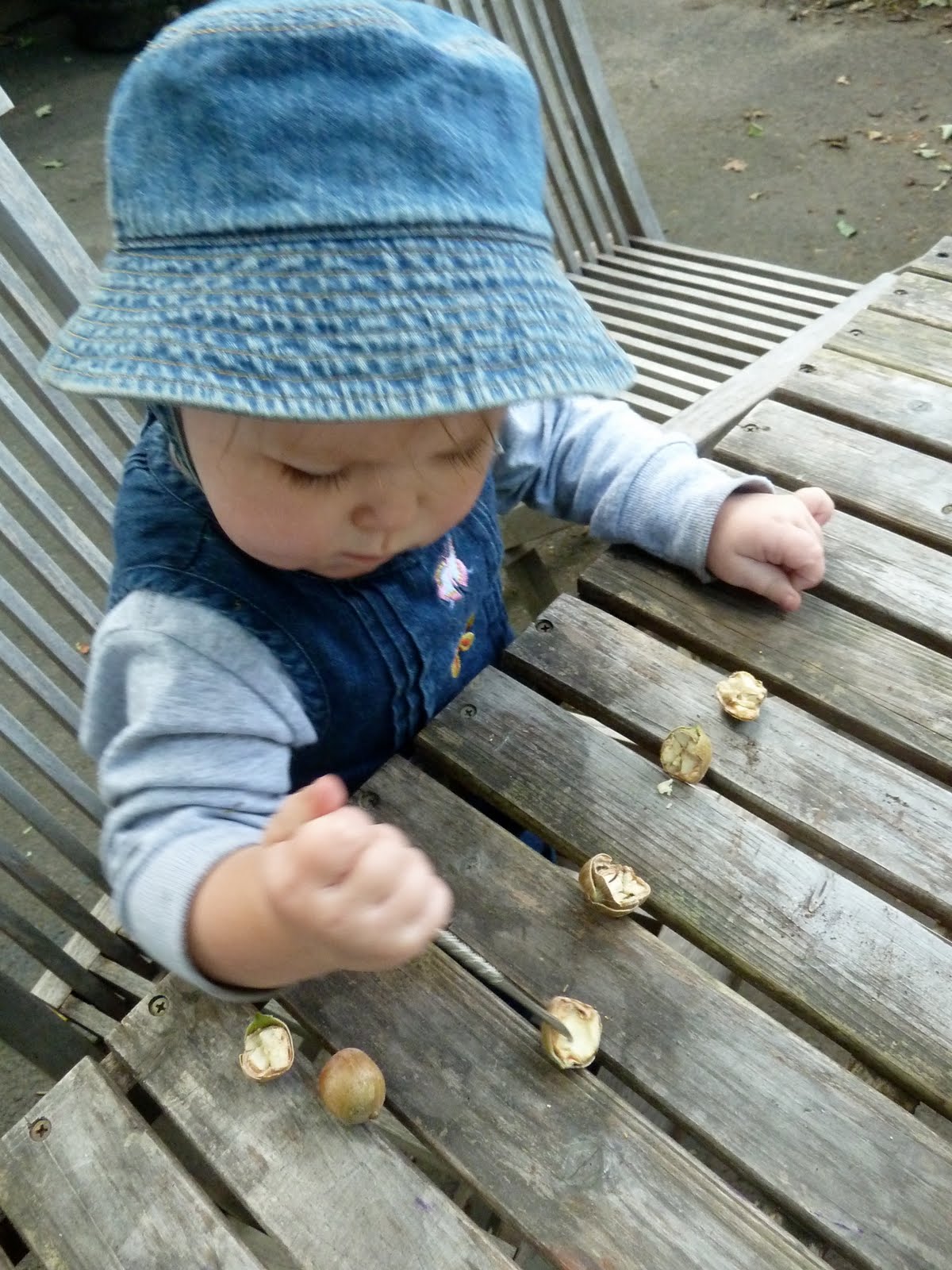
We used a hammer and a brick to break the acorns, and nutpicks to remove the meat.

Acorns to be processed, caps for the studio, shells for the compost.

This morning, this invitation to continue the work awaited them on the coffee table, along with a book which elicited many shouts of "we picked those!" (Oh, I had such fun pulling books to support this interest! I'll share a book list soon.)

The hunt for crabapples was disappointing (they were mostly gone), so we moved on to gathering wild grapes and goldenrod, instead.

Heading home after a successful foraging expedition.

At the moment, we've got acorns waiting to be cracked and processed into acorn meal (with the promise of acorn bread in our future--for the equinox, maybe?), wild grapes and crabapples dripping juice through a bag, to be made into jelly, and goldenrod waiting to be made into salve. And those are just the with-the-kids projects; never mind the tomatoes, beets, carrots, and more I plan to preserve this week!

Monday, July 12, 2010

Independence Days: filling the freezer with fruit


Time again for Sharon's Independence Day's Challenge:

1. Plant something:
I'm just happy I didn't kill anything more this week! The container garden loved the heat this week--I can't believe how much the beans grew!

2. Harvest something:
12 qts. cherry plums foraged from a nearby park. 6 qts. raspberries from a pick-your-own farm. Eggs. The last few of our snap peas. The usual garden snacking (Lucy's learned to ask "mint?" just before picking and eating some). Our first grape tomato (which was then cut into 6 equal portions to be shared by the kids at lunch) :-).

3. Preserve something:
5 pts. pickled beets. 8 qts. frozen raspberries.

4. Waste not:
I've started tucking re-usables into my shopping bags so I won't forget them. Yogurt containers and berry boxes go into our CSA bag, because they'll re-use them. Coffee bags go into a specific bag for the co-op, so we can re-fill it. Makes remembering much easier!

5. Preparation and storage:
Our stores are woefully low. We're re-stocking slowly: a few extra jars of coconut oil, a few of peanut butter, a few recycled bottles filled with water.

6. Build community food systems:
I told several people about the cherry-plum discovery. And, of course, being the wacko on the side of the road with a basket always invites looks and inquiries. It feels like my small little contribution to educating the world about the possibilities of foraging.

7. Eat the food:
Lots and lots of popsicles. Favorite flavors this week:
strawberry/yogurt
strawberry/spinach/coconut milk
blueberry/summer squash/spinach/water
Lots and lots of kale. Kale chips, of course. And a surprisingly-good what's-in-the-fridge concoction that all the kids liked (loose recipe below). It was such a hit, I made it again today, and the kids kept saying "this is my favorite rice!" Potato salad, cucumber salad, green salad (salad was clearly a theme this week!). Lots of berries, just straight up. And just tonight, I conquered a fear of mine: I made a pie crust. I know, it's supposed to be easy. But I've always hated things I have to roll out--they get stuck to the rolling pin and rip and break. So I buy pre-made crusts. Or mostly, just avoid anything that requires a crust. But today, I did it! It's baking now, but it looked like it worked!

Spicy Kale, Eggs, and Rice
Chop a bunch of kale into small pieces. Saute in a bit of oil until bright green.
Push kale to the side of pan; break a few eggs into the pan, scramble, and cook.
Add cooked rice. Pour in lots of watery salsa (or salsa+water).
Cook until water is absorbed or evaporated.

Sunday, July 11, 2010

My berry, your berry

I mentioned those cherry plums I'd recently discovered. The kids and I were in the park with nothing to do, and they spotted some yellow fruits on the ground. "What are these?" My first thought was unripe crabapples. But then why were they all over the ground? Then Lucy handed me one she'd bitten (yup, she's teething), and I saw a pit inside. I smelled it--it smelled like a plum. But it was tiny! I'd never heard of such a thing. So I looked it up, and found out they're called "cherry plums." They're about the size of cherries; they can be red or yellow; and they're often used as landscaping plants. Oh, how I love the person who, choosing landscaping plants for a public park, decided upon edible fruit trees! Shouldn't all parks have food we can share? Look at the bounty on just this one tree:

We picked some Saturday--probably a bit early, but I wanted to be really sure we didn't miss them. (I'm hoping they'll finish ripening at home, and then we'll make some jam.)

Andi hung from a branch to pull it low, I picked all I could reach, and Lucy picked up any we dropped on the ground. It was quick work for us to pick 12 quarts of plums.

Sunday was for raspberries. Never mind the humidity and heat in the 90s; we had to pick. We hadn't found a good pick-your-own raspberry place until this year, and they were too expensive to buy in quantity at farmer's markets, so we haven't done raspberry jam in a few years. But it's my favorite! Plus, I want more variety in our stored fruits this year, so I wanted some to freeze.

You can tell Lucy's been raised eating locally. We told her we were going to pick raspberries. She's never done that before, but clearly, pick-your-own is familiar to her. When we got to the farm, I handed her a box and without any further instruction, she went straight to the canes, picked a ripe berry, and dropped it in her box!

Of course, some went into her mouth, too.

And a few into her hat.

(I love these little collections vignettes she leaves behind wherever she goes!)

We only managed 6 quarts before we were melting too much to continue, but that should be enough to keep us busy for a while!

Now my mind is humming the picking-fruit songs. Saturday was "picking up cherry plums and putting them in the basket..." (originally pawpaws--and, hey, looking it up for you, I just learned a ton of new lyrics to this song!). Today was "three berry, four berry, my berry, your berry." Is it just me, or do you have a kids' song for every occasion?

Monday, June 21, 2010

Independence Days challenge update: strawberries!

Apparently, I don't blog well on nice-weather weekends! (Didn't help that our camera's acting up and we got no photos of the world's most picturesque strawberry-picking day or our beach-with-friends day...) So, here it is, time again for Sharon's Independence Day's Challenge:

(back from the farm, we set up outdoors to prep the strawberries for the freezer)

1. Plant something:
Hablitzia (climbing perennial spinach)--I was excited to discover a perennial-vegetable plant stand at the farmer's market this week! I asked what would grow in shade, and this is what he recommended; I remembered having read about it in my forest gardening book, once he mentioned it. I added two of them to my fledgling forest garden.

Roma tomatoes, more double yield cucumbers, and light red kidney beans from seed in pots on the driveway. (My neighbor came home from vacation, and seeing our new pots-on-driveway garden, asked if we needed any more containers. Yes, we do! She lent us two ceramic planters and a metal refrigerator drawer, so we put in more seeds. I know I'm getting a too-late start on some of these seeds, but I figure we might as well put them in and see what happens.)

(peas in our under-clothesline planter box)
2. Harvest something:
Eggs. Good King Henry, swiss chard. Chives and mint by the kids, doing their daily garden snacking. Foraged elder flowers. 15 quarts strawberries (After years of looking, we finally found organic pick-your-own strawberries on a wonderful farm. We'll be back soon; 15 quarts is not enough. But it's what Lucy could stand in the heat.) A few peas from our garden. One black-cap raspberry! :-)

3. Preserve something:
I discovered tons of elder growing at our CSA and worked up the nerve to ask if I could take some flowers. They said yes, so I made elder flower tincture. We also froze 12 quarts of the strawberries.

5. Preparation and storage:
Added a jar of water to storage.

(potatoes growing in a trash can in our garden)

6. Build community food systems:
Nothing much, though we did make plans to bring friends back to the farm to pick strawberries.

7. Eat the food:

(happy strawberry-stained baby)
Salad. Kale chips. Strawberries with corn cake (mmmm). Strawberry lemonade (lemons are my one non-local produce exception, but even still, lemonade is a rare treat for us). Tons of just-plain strawberries. Radish sandwiches. Snap peas. Lots of simple picnic-y fare.

Monday, April 26, 2010

One post, three challenges


Time again for Sharon's Independence Day's Challenge:

1. Plant something:
Resina calendula and sugar snap peas from seed (good toward the Growing Challenge). Highbush cranberry, golden horn tree, salal, and nagoonberry (that's what was in the big box).

2. Harvest something:
Eggs, dandelion greens, violets, good king henry, sorrel, sweet cicely, and chives from our garden and yard. Garlic mustard foraged from a nearby abandoned yard (this is a new food to us).

3. Preserve something:
Made garlic-mustard pesto to freeze.

6. Build community food systems:
Some of the kids went home talking about the green smoothies--which turned out to be a new idea for some of the parents--and some kids are now gathering dandelion greens and giving them to their parents to eat. So I shared the "recipe" for our smoothies in one of my daily emails to the families in my program.

7. Eat the food:
I served the kids green smoothies three times this week, with mixed results (some love them, some don't--but I fear a bit of that is peer pressure). Lucy continues to love them. And all the kids love the idea of them, and love gathering greens for them, so it's going to become a regular snack around here (I trust that their taste for it will come with time--and with the arrival of fresh fruits!).

We also ate a yummy yogurt dip made with chives and teeny bits of other herbs from the garden (all I've got so far): plain yogurt, lemon juice, herbs, salt, pepper. It was great on green beans (1st day) and on roasted cauliflower (2nd day). And ate garlic mustard foraged from a nearby yard. Hated the recipe I used, but think I could like the greens. Will try again.

And then there were these. Oh, my goodness. Don't make these if, like me, you have trouble with--shall we say--portion size. I found the link here. Not the slightest bit local or sustainable, I'm afraid, but a good made-from-the-pantry treat.
...
Outside today, I finally removed a terracotta planter which sat at the base of this tree for a few years. We'd failed to take it in over the winter, so it had cracked to pieces, and it was so root-bound, I could barely get the soil separated from the pot shards. But I tackled the task today. To watch me, Lucy was inspired to climb up on the base of the tree, a new accomplishment of which she was very proud.

Once the pot was removed, there was a treasure-trove of insect life left behind: pill bugs, centipedes, and various larval creatures. Here, Lucy watches as the older children scramble to catch the fast-moving bugs to feed them to the chickens.

Monday, March 29, 2010

Independence Days challenge: first foraging


Time again for Sharon's Independence Day's Challenge:

1. Plant something:
Grandpa Admire's Lettuce (from seed). Raspberries (from a neighbor, delivered midwinter, frozen in the pot. They survived!). Green Arrow Peas (again; the chickens dug up the originals). Peas and lettuce apply to the Growing Challenge, as well.

2. Harvest something:
Eggs. Dandelion greens. Chives. Bits of sorrel. The sap didn't run this week, but I don't have nearly enough syrup; am hoping for another chance this week.

4. Waste not:
I got that great pile of books this week, which (in addition to being a passionate hobby for me and useful for my work with children) will be a part of my children's education, so I consider it "preparation." I got that great

7. Eat the food:
The kids and I had the first green eggs of the season, made with foraged dandelion greens and chives and sorrel from the garden. I made these cheese crackers twice this week, and oh, my gosh, are they amazing! Crackers is one of those packaged foods I just hadn't learned to make yet, but now I can't wait to try some other recipes (got any good ones?). These are like Cheez-Its, but much more delicious (and real). I also made two batches of wonderful granola this weekend (one with dried elderberries, one with dried strawberries). And I made a batch of bread dough to have on hand this week (something I'd like to do every week--not quite there yet.) I need to have more baking weekends like this, so the house is full of goodies and we're not tempted to buy meals out.

Friday, October 2, 2009

Don't try this at home

My latest experiment in herbal remedies has been making goldenrod tea and goldenrod oil. If you'd like to learn how, too, read Lisa's excellent post here.

This, on the other hand, is how not to do it.

Go for a walk in the twilight hour, and fill the basket of your stroller with goldenrod in the dimming light. At home, drop the heap on your kitchen counter to deal with later:


Get your baby out of the stroller and put her on the floor to crawl.

Note with mild interest, "hmmm...wonder why the cat's so interested? Does it smell like catnip?"

Return later to notice this:


And this:


Yup, there were 5 bees in there. And that one on the floor? Not so happy.

Monday, September 28, 2009

Independence Days challenge, week 22

Time again for Sharon's Independence Day's Challenge:


Lucy comes for a bite of pear as Andi preps them for canning, arm-chair style.

1. Plant something: No. Must become a better gardener!
2. Harvest something: Eggs. Goldenrod.
3. Preserve something: Canned 9-1/2 qts. grape juice, 1/2 pt. jalepenos, 12-1/2 pts corn relish, 4 pts. ketchup, 9 qts. pears. Dried goldenrod, 3 pts. tomatoes. Froze 2 lbs. broccoli, 4 lbs. tomatoes.
4. Waste not: Same old, same old.
5. Preparation and storage: Re-organized canning shelves into clear categories (pickles, ketchup/salsas/chutneys, canned fruit, jams/jellys/syrups), tomatoes/tomato sauce).
Got a big pile of future homeschooling books at a book sale.
6. Build community food systems: Blogged about how we organize our food storage inventory. Continued canning "lessons" for friends.
7. Eat the food: Nothing new here.

Monday, September 21, 2009

Independence Days challenge, week 21


Time again for Sharon's Independence Day's Challenge:

1. Plant something: No.
2. Harvest something: Eggs. Mystery squash from the compost bin. Crab apples from a local park (with the kids). 4 pecks pears and 1 peck peaches from Quonquont Farm.
3. Preserve something: Canned 3 qts. pears, 3/4 pt. pear butter, 16 qts. tomato sauce, 3-1/2 pts. peach salsa, 27 1/2-pints crab apple jelly, 1/2 pt. peach honey, 10-1/4 pts salsa, 6 qts. tomatoes, 5 pts. tomato juice. Froze 2 qts. green pepper, 2 qts. red peppers.
4. Waste not: Saved money and waste by picking up "drops" under pear and peach trees rather than from the trees.
5. Preparation and storage: Worked on cleaning and organizing canning shelves.
6. Build community food systems: Gave canning advice to a parent in my program. Taught two friends to can and helped them can their first batch of tomato sauce. My proud moment of the week came as we walked back from the park and one tired child asked "is your house close?" and another answered "you just have to turn after that mulberry tree." It's true; I'm raising 4-year-old foragers.
7. Eat the food:Nothing new here.

Saturday, September 19, 2009

Canning central

Friday was a gorgeous fall day, and the kids and I, joined by some friends, walked to the park to pick crab apples.


Today, it's canning central in our kitchen, with us and two sets of friends canning in shifts. Here you see 2 pots of Barbara Kingsolver's "Family Secret Tomato Sauce," a pot of peach honey, and another of crab apple jelly, all boiling down at once.


On these marathon weekends, we can all day and into the night. Here's our outdoor set-up around 10:00 this evening: still processing.

Monday, September 7, 2009

Independence Days challenge, week 19


Time again for Sharon's Independence Day's Challenge. We just got back home late Friday night, so this is what we did on the long weekend. Yup, it was crazy!

1. Plant something: Nope.
2. Harvest something: Eggs. A few grape tomatoes. 11 lbs blueberries from Running Fox Farm, 3 pecks peaches and 3 pecks pears from Quonquont Farm, elderberries from neighbors and roadsides. Red clover.


3. Preserve something: Dried 1/2 pt. elderberries and ? blueberries (they're still in the dehydrator). Canned 19 qts. peaches. Made 3 pts. elderberry sryup. Froze 1 1/2 lbs blueberries. Canned 9 1/2 pts. "blubarb" jam (blueberry-rhubarb), following this recipe from Chez Beeper Bebe. Canned 5 1/2-pts. peach-blueberry jam. Got ? 1/2 pts. peach honey, 2 1/2-pts. elderberry-peach jam, and 5&1/2 pts. quince pectin from our friend who was canning with us (we share labor and our kitchen and supplies; this was our share of what he made).
4. Waste not: The peach honey was a good example of using all the scraps--it's made from the peels that would otherwise have gone to the chickens (they got them afterwards).
5. Preparation and storage: Working on getting our canning shelves re-organized.
6. Build community food systems: While chicken-sitting for us this past week, our friend decided he wants to get some chickens, too (yes, we recruit!). And we've been canning, as usual, with these friends, which makes it a community experience, and much more fun, too. One of them worked up the nerve to ask some (politically polar-opposite to us) neighbors for their elderberries, something we've been wanting to do for years. They said yes, in exchange for a jar of jam. The husband was very eager to try them, as previously "we just let the birds have them."
7. Eat the food: We ate a lot of take-out to accomplish all this in a weekend. But we did have a great dinner of roasted veggies and fruit cobbler.

Monday, July 6, 2009

Independence Days challenge, week 10


Time again for Sharon's Independence Day's Challenge:

1. Plant something: Nothing.
2. Harvest something: Eggs. Mulberries. Clover. Kale. Good King Henry. Garlic scapes. Strawberries (bartered labor for berries at a local organic farm; that's Lucy, "picking berries" above).
3. Preserve something: Canned 7 1/2 pints mulberry jam (from this recipe), 3/4 pint strawberry-lemonade concentrate, 2 pints strawberry-quince preserves. Dried 2 pints strawberries, 1 pint dill, 1 pint red clover blossoms, 4 pints mulberries. Froze mulberries, strawberries.
4. Waste not: Nothing new.
5. Preparation and storage: Organized past two years' preservation lists into a notebook to use as reference for this year.
6. Build community food systems: Spent a lot of time, while making a spectacle of ourselves at the mulberry tree, talking with neighbors about foraging and mulberries. Brought the children in my early childhood program foraging for mulberries and clover.
7. Eat the food: Finishing off the last of 2008 preserves.

Wednesday, July 1, 2009

Foraging with children


Andi and I made a commitment two years ago to eat only local fruits and vegetables. This means a great deal of time is spent gathering and preparing local produce for storage. The children in my early childhood program are included in that process, and therefore know a lot about where food comes from, what's in season, and how to preserve food. This week, they helped me forage for local goodies: mulberries (to be dried and added to winter granola, as well as to be eaten fresh) and red clover (to be dried for tea).