Showing posts with label tutorial. Show all posts

Monday, September 21, 2009

What's on the basement shelves?


So why all the food preservation talk around here? A few years ago, (after reading Barbara Kingsolver's then-brand-new book Animal, Vegetable, Miracle, of course), we decided to make a much more concerted effort to buy only locally-produced food. As with many other decisions we've made, we decided to see how far we could go, and never turned back. For us, it's come to look like this:

We eat only locally-grown produce (with the exception of lemons, which we haven't been able to do without. And dried coconut. We all have our weaknesses.) Because we live in New England, this means we have to preserve a lot of food in order to eat in the winter.

We try to choose locally-produced other foods, whenever possible.

We try to avoid buying packaged, processed foods. We do better or worse at this depending on how crazy our life gets. This winter, I am determined to return to baking bread, and making yogurt, for example, but for now, we're buying those.

It became clear early on that we'd need a system to keep track of what we'd stored, to help us use it up efficiently, and to help us remember from year to year what worked and what didn't. Above, you can see the system we're using now, our food storage inventory. On graph paper, we keep track of "item," "date," "source and recipe," "quantity and status," and "notes." (You can click on the picture to see it larger.)

Under "item," we list the name of what we've stored, using specific recipe names if applicable so we can remember which recipe we'd used. We list everything from dried herbs to frozen veggies to canned jam to storage squash all on the same inventory. Some day, I might further organize things by type, but for now, it's all organized chronologically.

The "date" part helps us remember what's in season when so we don't miss mulberry season, for example.

Under "source and recipe," we note where we got the food--which farmer, friend, or foraging spot. And we write down where we found the recipe so we can find it again. "CBHP," in the photo above, for example, is the Ball Complete Book of Home Preserving.

Under "quantity and status," we make a slash in a box for each item, and write below what size it is: gal. bag, or 1/2 pt. As we bring it up from storage, we put another slash through it, making an X, to mark it gone. This way, we can see at a glance what we have lots of and what we should use sparingly. As I plan meals, I use this tally to help me figure out what we should eat.

In the final "notes" column, I write down if we loved or hated it, if I altered the recipe, if I bought too much and it all rotted, or whatever might be useful the next year.

Now, back to the kitchen. There's lots more pages to fill if we're to keep to this commitment this year!

Friday, September 18, 2009

How to make felted-sweater diaper covers

I had a request for more information about how to make diaper covers from felted wool sweaters. There are several good tutorials out there, so I'll point you in that direction rather than re-write what's already been said. But I've picked up a few tips along the way and combined two patterns last time, so I'll share some of what I've figured out here.

P1010029

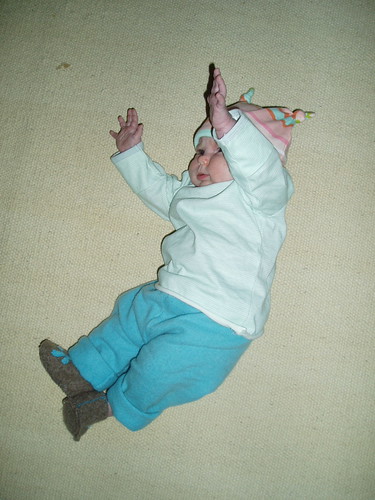
This is the first tutorial I came across for making wool "longies" (long pants that serve as a diaper cover). I've followed this basic design for most of the longies I've made. They are really cute and useful. (Lucy's modeling a pair, above.) As she gets bigger, I'm finding that these are sometimes too short in the back. I'm going to experiment with some different waistbands. I loved these--how smart to use the cuff of a pair of pants as the waistband! Other tutorials I've seen use some of the waistband of the sweater to make a waistband for the longies--a great idea I want to try. And I've never tried this pattern, but it looks very promising; I like the fitted bottom.

*edited to add: How embarrassing! I was looking at Lucy's diaper peek above her too-short-waisted longies tonight and realized what was wrong with them. My own stupidity; I forgot to allow for the casing when I was cutting down the side of the sleeve! I just cut it to match the pants I was using for a "pattern," so when I added the elastic casing, I lost nearly an inch. I'd still like to try those other ideas, but now I'll also be able to make these and have them fit! Can you say sewing while exhausted?

I also love this pattern for a "bum sweater". Here's the first one of these I made. Super cute shorties (short pull-on diaper cover), and nice and trim. It fits well under clothing and also looks cute under summer dresses. I don't put in the recommended drawstring, and so far, haven't needed it.

When I made the pink pair, I followed the suggestion to use the cuffs of the original sweater as the leg bands. But that meant that when I later made longies from those sleeves, they didn't have a nice finished edge. For less waste, and a more finished product, for the brown pair I made next, I cut the neck of the original sweater in half and used those strips to make the leg bands. Much better.

The bum sweater is also the pattern I started from to make her latest cashmere longies. Rather than sewing on legbands, I sewed on long legs made from the sleeves of the sweater. The sleeves were long enough that I was able to cut them in half and make two pairs. However, I'd cut the top of the sleeves off the sweater following the angle of the shoulder--so they came to a point--and I decided to try to incorporate that into the design, to see if it would give her more space around the diaper. You can see how the legs come to a point at the top in the pair on the right, below:


I like how they fit, but they come down a bit too low in the front; I think this pair would benefit from an added drawstring.

To make any of these diaper covers, you'll want to start with a largish, not-too-scratchy, 100% wool sweater. I use no special techniques for felting--I just throw the sweater in the washer and the drier and let them do their thing, and then decide what to make out of it based on how big it ends up! Once you've made your cover, you'll want to lanolize it to help it absorb water. I dissolve a few drops of liquid lanolin (from the health-food store) in a bit of hot water, then fill my bucket with room-temperature water, let the covers soak for a while, rinse, squeeze out the extra water by rolling them in a towel, and then hang to dry. It takes forever for them to dry that first time, but don't worry--you only have to lanolize them every month or so.

Well, now, that was wordy! Hope it's helpful! Let me know if there's anything I should clarify or add.